Celebrating its 400th anniversary this year, the French Navy is entering one of its most significant periods of transformation in generations, confronting a maritime environment that is becoming increasingly complex, contested and technologically driven.
Celebrating its 400th anniversary this year, the French Navy is entering one of its most significant periods of transformation in generations, confronting a maritime environment that is becoming increasingly complex, contested and technologically driven.
That challenge took centre stage at EURONAVAL, the biennial maritime defence exhibition in Paris, where French Navy officials and international partners discussed emerging operational requirements as industry unveiled the capabilities and innovations designed to meet them.
Across the event, senior government representatives and service leaders underscored a common set of priorities: Information dominance; force protection; and the ability to project power.
In her opening keynote, Catherine Vautrin, France’s Minister for the Armed Forces and Veterans Affairs, called for a sovereign, competitive and internationally-oriented defence industrial base- one that “harnesses innovation to achieve operational superiority and prepares a combat-ready navy for the challenges of high-intensity warfare and cooperation in support of maritime security”.
Against the backdrop of France’s increased €63.4bn defence budget for 2027, Vautrin outlined a series of future efforts, including an “expansion of naval drone capabilities”- a move designed to enable the navy to “sustain high-intensity warfare over the long term”.
She also challenged industry to accelerate innovation and production. “Our first weapon is our ability to produce in Europe,” she declared, before signing the Naval Drone Pact- an initiative aimed at strengthening collaboration between the navy and industry in areas of unmanned surface vessels (USVs), underwater systems (UUVs) and remotely operated munitions.
The shift towards unmanned systems was also evident in discussions centred around the underwater battlespace. Vice Admiral Xavier Petit, Commander of the French Strategic Oceanic Force and Submarine Forces, examined the growing role of unmanned systems beneath the surface, while Captain Alexis Muller, also of the French Navy explored emerging applications and requirements for drone-carrier platforms.
Yet as naval operations become increasingly distributed, persistent maritime awareness remains a formidable challenge. Rear Admiral Hugues Lainé, Maritime Operations Commander of the French Navy, highlighted the limits of continuous wide-area surveillance, arguing that even with military and commercial satellite constellations, achieving it remains “almost impossible”.
“The maritime domain also offers considerable freedom of manoeuvre for any type of asset,” he said, pointing to AIS manipulation, spoofing, concealment and underwater assets that are difficult to detect.
As the French Navy looks to extend its reach across an increasingly complex maritime battlespace, the challenge for industry is clear: Deliver technologies capable of operating where conventional systems fall short.
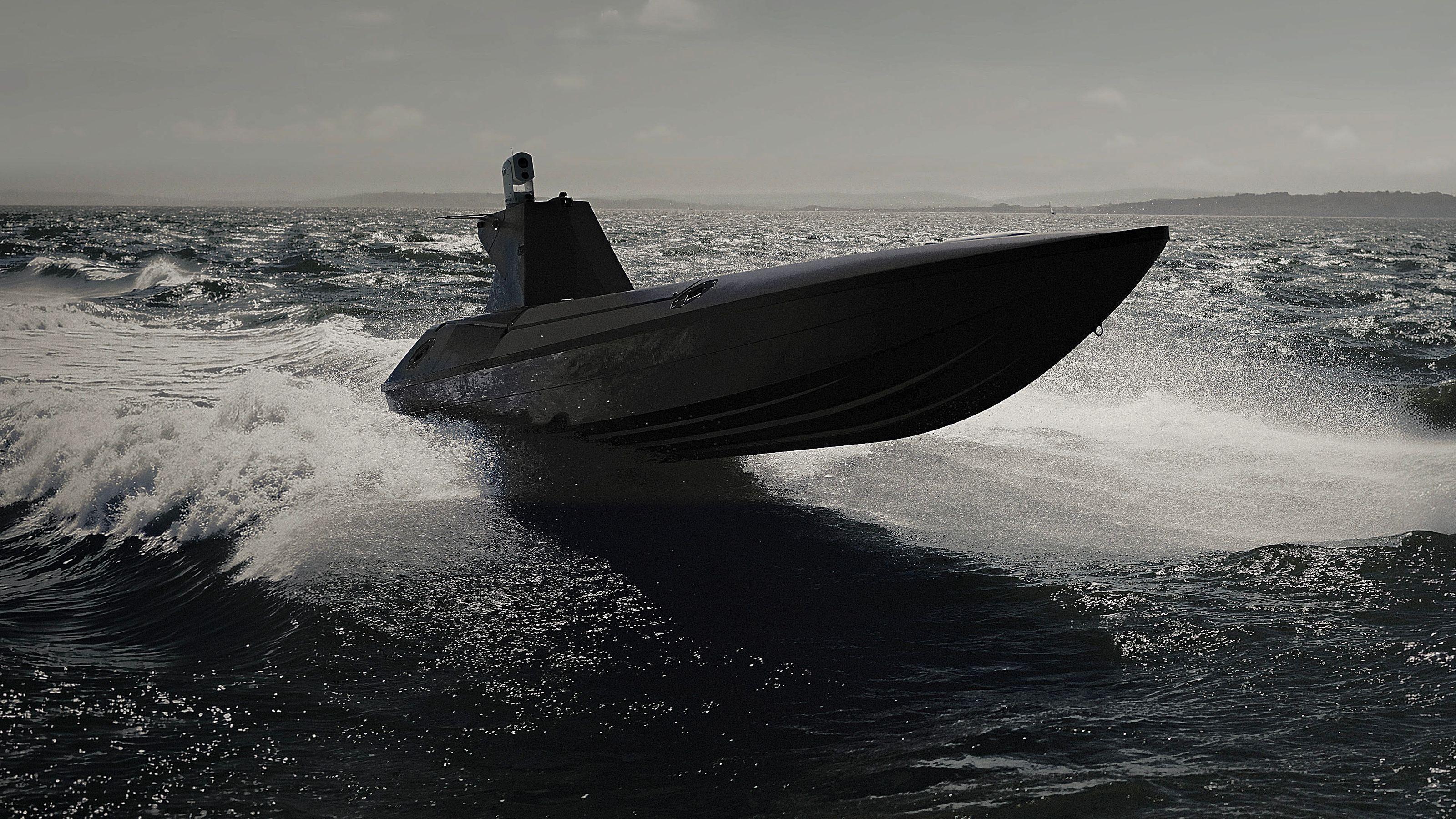
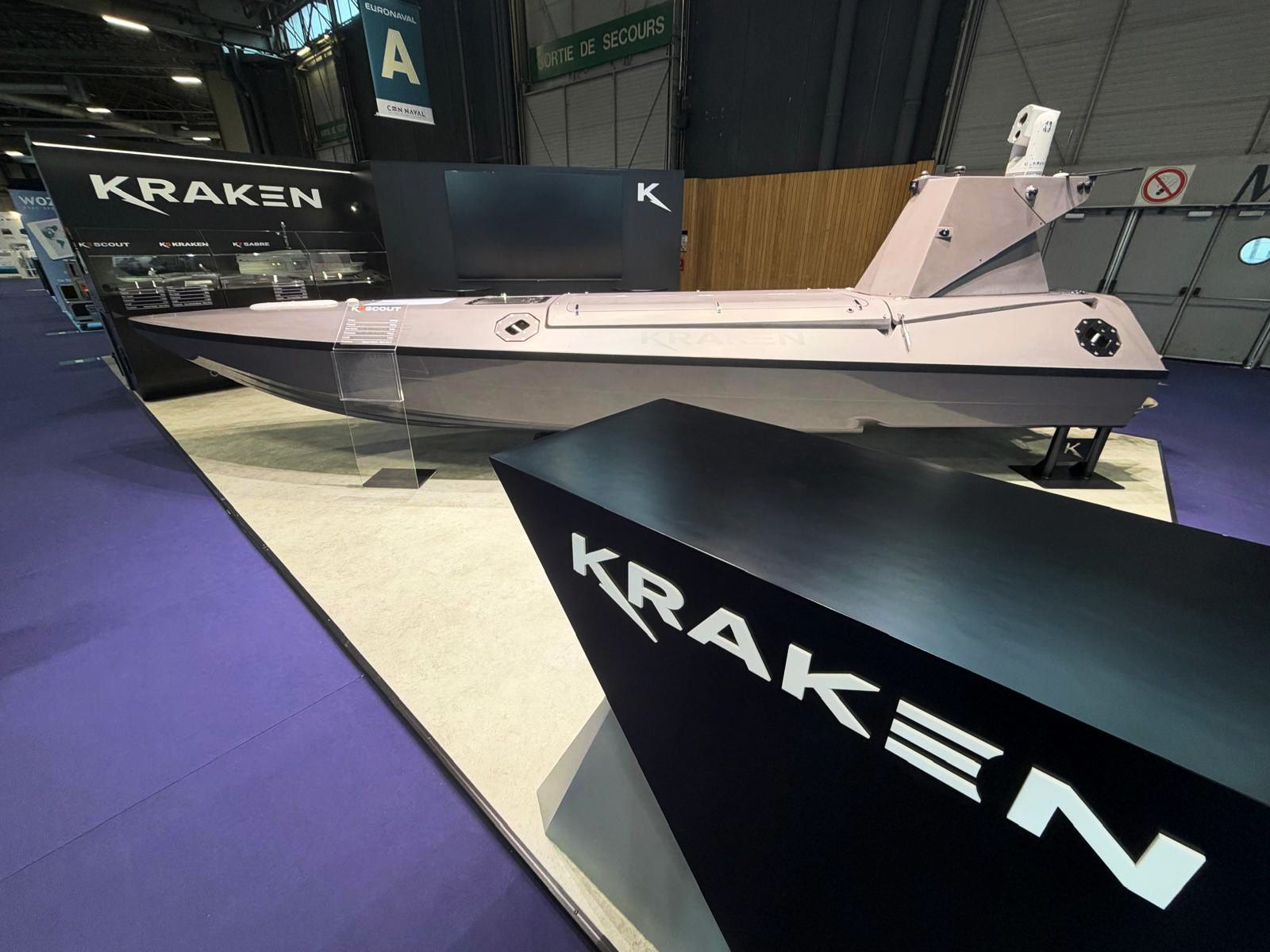
Among the companies bringing these capabilities to EURONAVAL was Kraken Technology Group, which placed its K3 SCOUT USV firmly in the spotlight, with two platforms on display across the exhibition.
At Rheinmetall’s stand, one K3 SCOUT offered a glimpse of the emerging convergence between unmanned maritime and aerial systems. The vessel- already in series production at Rheinmetall’s Blohm+Voss facility in Hamburg- was presented with a modular payload bay carrying a pair of Ukrainian-designed Arrow R120 quadcopters. The configuration points towards a battlespace in which surface vessels can act as mobile launch platforms for aerial assets, extending operational reach beyond the platform itself.
A second K3 SCOUT occupied Kraken’s own stand at EURONAVAL, where it shared the space with a scale model of the company’s larger K7 SABRE.
At 26.5m, K7 SABRE is designed to operate at a markedly different scale, with a payload capacity of 24,000kg and an endurance of up to 30 days at sea.
Together, the two platforms illustrated Kraken’s approach to unmanned maritime capability: A high-speed, modular craft capable of rapidly adapting to mission demands through to a larger vessel designed to deliver substantial payload capacity and persistent presence at sea.
Defence Journalist
Andrew White is a defence journalist and British Army veteran, with deep expertise across modern military operations and emerging technologies. He has written for leading industry publications including Shephard Media and brings strong operational credibility to his reporting. Now working as a senior copywriter with Kraken Technology Group, he supports the development of strategic communications across defence, autonomy and advanced maritime capability.