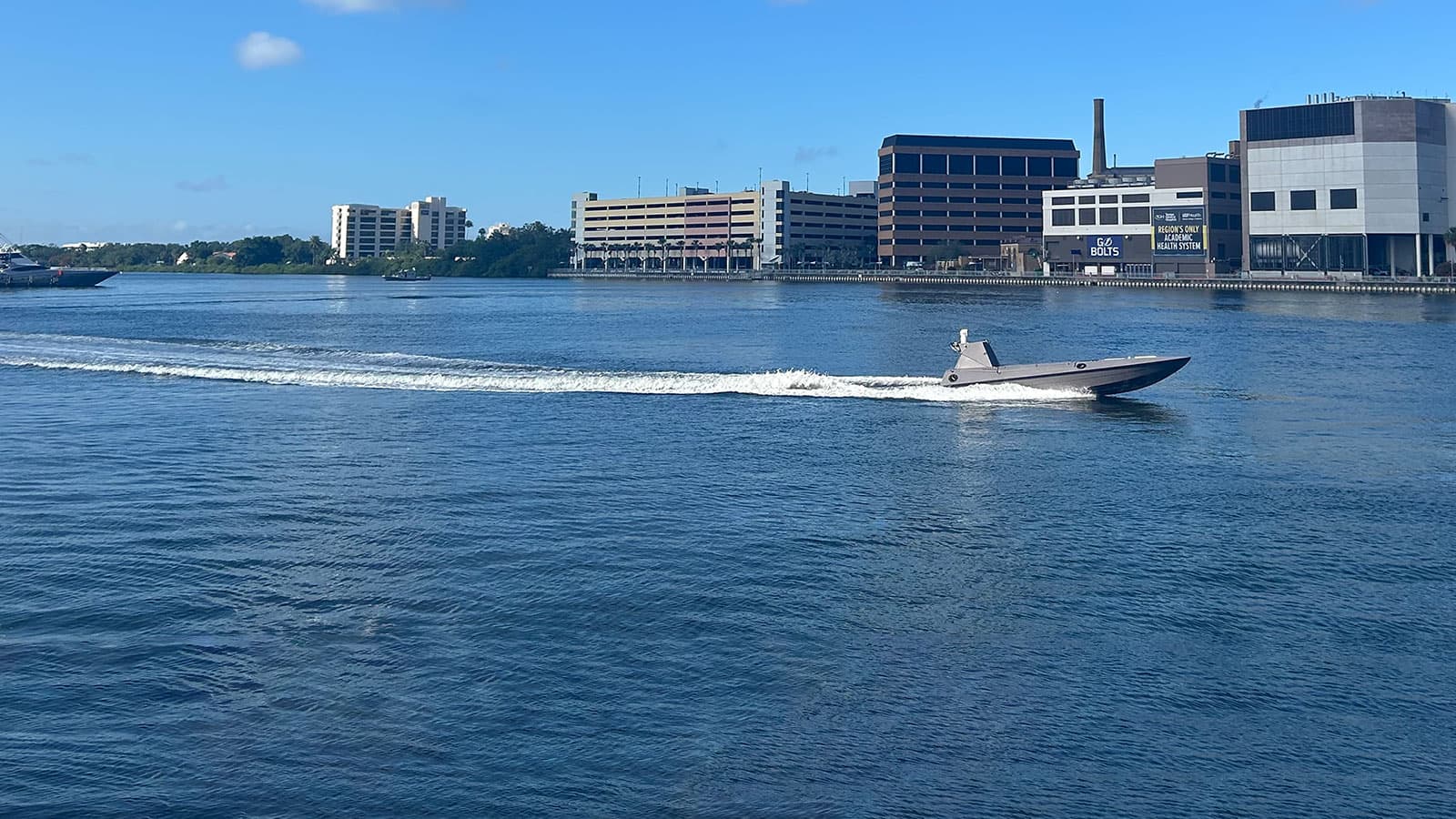
In the vast expanse of the Indo-Pacific, military leaders are beginning to envision a new model of maritime security: persistent networks of autonomous surface and subsurface systems operating collaboratively across allied nations.
The year is 2030. Across the Indo-Pacific, a new kind of maritime fleet is taking shape - one with minimal crews, fluid command structures and the ability to remain at sea for extended periods.
A coalition of like-minded Indo-Pacific nations operates a dispersed but highly integrated network of uncrewed surface and subsurface vessels, designed to provide persistent presence and deter strategic adversaries across the theatre.
USVs, USSVs and UUVs work together across the region’s vast maritime spaces, detecting, characterising and attributing activity at sea, while sharing data across the network to build a persistent picture of the maritime environment.
The aim? To identify and expose actors seeking to disrupt freedom of movement or undermine stability and sovereignty across the Indo-Pacific.
Such a concept of employment does not yet exist. But it represents an emerging aspiration among senior US special operations leaders, who discussed the future of autonomous maritime systems with international partners at the annual Indo-Pacific Irregular Warfare Conference in Honolulu, Hawaii, on 18-19 August.
Set against the glamorous backdrop of Waikiki Beach, service leaders discussed how autonomous platforms could move to the forefront of security operations across the vast expanses of the Indo-Pacific in the not-too-distant future.
Brigadier General Michael Rose, Commander of US Special Operations Command Pacific, led the discussion, calling for a “new way of thinking for irregular warfare and autonomy” as part of a broader strategy to deter adversaries across the theatre.
Rose argued that the US and its allies and partners across the Indo-Pacific should combine their respective strengths to accelerate the development and adoption of autonomous systems - ultimately creating a multinational network of distributed platforms operating across the region.
For Rose, uncrewed systems could enable a “new generation of campaigning”, allowing forces to observe, detect and deter adversarial activity while simultaneously challenging an opponent’s decision-making.
“We must outfight and outthink them,” he said, describing the intersection of irregular warfare and autonomy as an “extraordinary opportunity” for the US and its regional partners. The concept, Rose suggested, could allow a coalition of nations to compete with strategic peers, helping to prevent conflict and, if war does come, enter it from a “position of advantage.”
Solving the problem of scale
In the Indo-Pacific, however, the challenge is as much geographic as it is technological. The distances are immense, strategically important locations are scattered across thousands of miles of ocean, and maintaining a persistent presence comes at considerable cost.
“We can't simply put a destroyer, an aircraft carrier, or a formation everywhere that we want to have awareness, influence, access, or presence,” Rose said.
Autonomy, he argued, could fundamentally change that equation: “Imagine persistent networks of relatively inexpensive autonomous systems conducting maritime domain awareness, environmental sensing, communications relay, logistics, indications and warning, or intelligence collection.”
Unlike conventional platforms, these systems would not necessarily need to be operating continuously to have an effect. Their value, Rose suggested, lies in their ability to remain distributed across an area for extended periods, creating a persistent presence that conventional forces cannot easily replicate.
“A ship eventually has to return to port. An aircraft has to land. People have to sleep, but a distributed, autonomous network can potentially remain.”
That persistence could be particularly significant in the so-called competition below the threshold of armed conflict, where adversaries campaign continuously rather than waiting for a crisis to erupt. “Competition isn't episodic. Our adversaries campaign every single day,” Rose said.
From detection to deterrence
Rose then offered a more developed vision of what such a network might look like in practice: a distributed ecosystem of autonomous systems operated collectively by the US and its allies and partners.
“Those systems detect the activity, they characterise it, document it, share it across the network, and we expose it. Detect, characterise, attribute, share, expose.”
The significance, he argued, is that such a network could generate strategic effects without necessarily generating kinetic ones.
“No missiles are fired, no ships are sunk, and we may not even cross any sort of significant escalatory threshold. But we created an effect.”
By exposing activity and removing the ambiguity on which an adversary may rely, autonomous systems could impose costs without firing a shot.
For Rose, this represents a distinctly irregular-warfare approach to autonomy: the technology is not simply creating a tactical effect, but influencing behaviour and decision-making at the strategic level.
“The autonomous system isn't necessarily creating a kinetic effect; it's creating a strategic effect,” he said. “And that should change how we think about the requirements.”
From autonomous systems to autonomous campaigning
In his concluding remarks, Rose acknowledged that conventional military strength remains essential. But, he argued, it is no longer sufficient on its own.
“Autonomy gives us extraordinary ways to outfight them, but an irregular warfare approach can help us understand how autonomy allows us to outthink them.”
That means, he suggested, moving beyond individual autonomous systems towards autonomous campaigning; beyond exquisite platforms towards distributed networks; beyond US capabilities towards allied and partner ecosystems; and beyond conventional deterrence towards resilience and denial.
The question, ultimately, is no longer simply how many autonomous systems are needed to win a future war - but how those systems can fundamentally change the way nations compete long before that war begins.
Defence Journalist
Andrew White is a defence journalist and British Army veteran, with deep expertise across modern military operations and emerging technologies. He has written for leading industry publications including Shephard Media and brings strong operational credibility to his reporting. Now working as a senior copywriter with Kraken Technology Group, he supports the development of strategic communications across defence, autonomy and advanced maritime capability.