At SOF Week, USVs were no longer experimental — but central to how special operations extend reach, increase survivability and deliver effects.
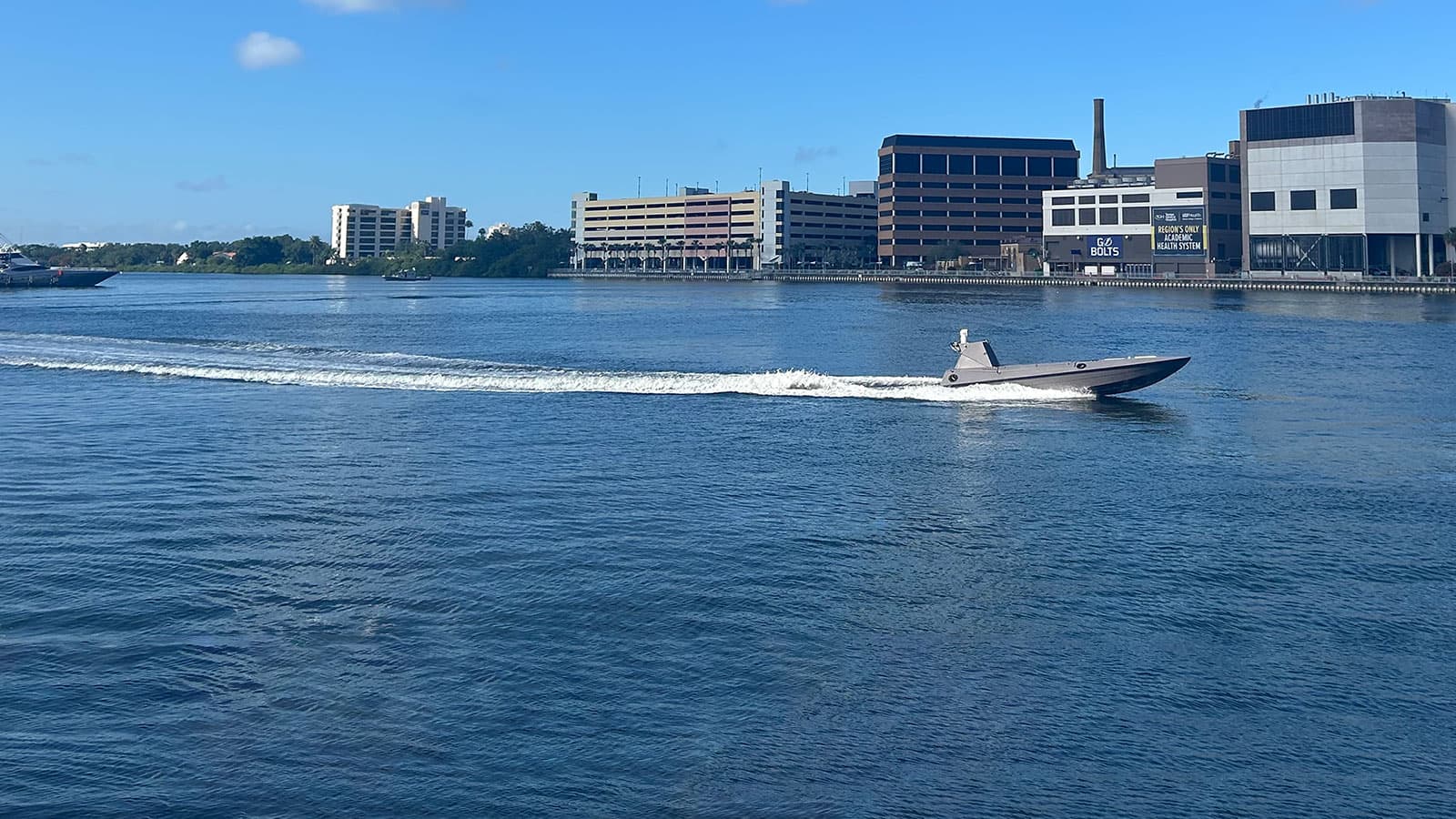
Under a blazing Florida sun, crowds lined Tampa's waterfront for one of SOF Week's most anticipated events: “Battle in the Bay,” the US Special Operations Command's biennial capability demo showcasing the latest warfighting technology.
The action began quietly.
Kraken K3 SCOUT slipped almost unnoticed through the Garrison Channel, moving with stealth towards a target vessel where Tampa Mayor Jane Castor was being held hostage by terrorists. On arrival, the platform launched UAVs to recce the basin and confirm the target. After establishing situational awareness, the uncrewed surface vessel (USV) silently backed away and relayed intelligence to a follow-on force of Navy SEALs, Green Berets, Army Rangers, Marine Raiders and international special operations personnel. Moments later, the assault force moved in, neutralised the threat and rescued the mayor.
It wasn't the first time a USV had featured in a SOF Week capability demo. But this year's appearance felt different. If anything, it highlighted just how far autonomous systems have come — and where they're headed next.
Throughout the week, USVs of every shape and size were front and centre in discussions across the exhibition floor and conference rooms. Increasingly, they're being viewed not as niche capabilities but as core operational tools for special operations forces looking to extend reach, increase survivability and deliver greater effects across multiple domains.
That message came through loud and clear from USSOCOM leadership.
In his keynote address, USSOCOM Commander Admiral Frank Bradley called for an “abundance of attritable and scalable systems to create a new kind of mass,” pointing to autonomous platforms as a way of giving the joint force greater flexibility and resilience across the future battlespace.
His Acquisition Executive, Melissa “Mojo” Johnson, echoed the theme, describing how USVs and other autonomous systems can deliver “operational reach and effects,” supporting precision strike missions, enhancing logistics in contested environments and ultimately improving force survivability.
USSOCOM also used SOF Week to outline several initiatives designed to accelerate the adoption of uncrewed maritime systems across the force.
Program Executive Officer for Maritime, Captain Jared Wyrick, revealed that the command is beginning work to formally classify USV capabilities and categories — similar to the framework the Pentagon established for unmanned aerial vehicles more than a decade ago.
Naval Special Warfare (NSW) and Marine Corps Special Operations Command (MARSOC) are leading the effort through the development of a joint “USV and UUV Family of Systems” Capability Development Document — a move which should simplify and speed up the selection and procurement of platforms across the force.
“It's pretty exciting,” Wyrick told attendees. “This doesn't exist today, so this is one of the first CDDs directly addressing USVs and UUVs in the joint force.”
The proposed framework will categorise systems according to size, displacement, interfaces, data standards, sustainment requirements and performance characteristics. Wyrick suggested a future Class III USV, for example, could measure around 40 feet in length, displace five tonnes and be launched and recovered from existing cradles aboard destroyer-class vessels.
But despite the excitement around hardware, Wyrick argued the biggest challenge isn't the platforms themselves.
Gesturing towards the water, he pointed to what he called “the nearest shark to this boat” — the issue of interoperability and user experience.
“Say we forward deploy operators to use several platforms that they haven’t been trained on that don’t have a common user interface? That would be a shame. But we can do something about it, and we can do it now,” he said.
For industry, the growing momentum around autonomous maritime systems was impossible to miss.
Kraken Chief Commercial Officer Erica Dill-Russell described this year's SOF Week as a turning point in how SOF operators think about and employ USVs across intelligence gathering, precision strike, contested logistics and broader multi-domain operations.
“It feels really different this year,” she said. “There is a continuous conversation around the development of USVs, and we're seeing significant operational interest in our platforms,” she added, referencing Kraken's research & development contract with USSOCOM signed in 2025.
As interest continues to grow, Kraken is planning to keep investing heavily in the sector.
“We are committed to investing ourselves, developing new technology capabilities and advancing prototypes across both the surface and subsurface domains,” Dill-Russell said.
If SOF Week was any indication, this is just the beginning for USVs.
Defence Journalist
Andrew White is a defence journalist and British Army veteran, with deep expertise across modern military operations and emerging technologies. He has written for leading industry publications including Shephard Media and brings strong operational credibility to his reporting. Now working as a senior copywriter with Kraken Technology Group, he supports the development of strategic communications across defence, autonomy and advanced maritime capability.