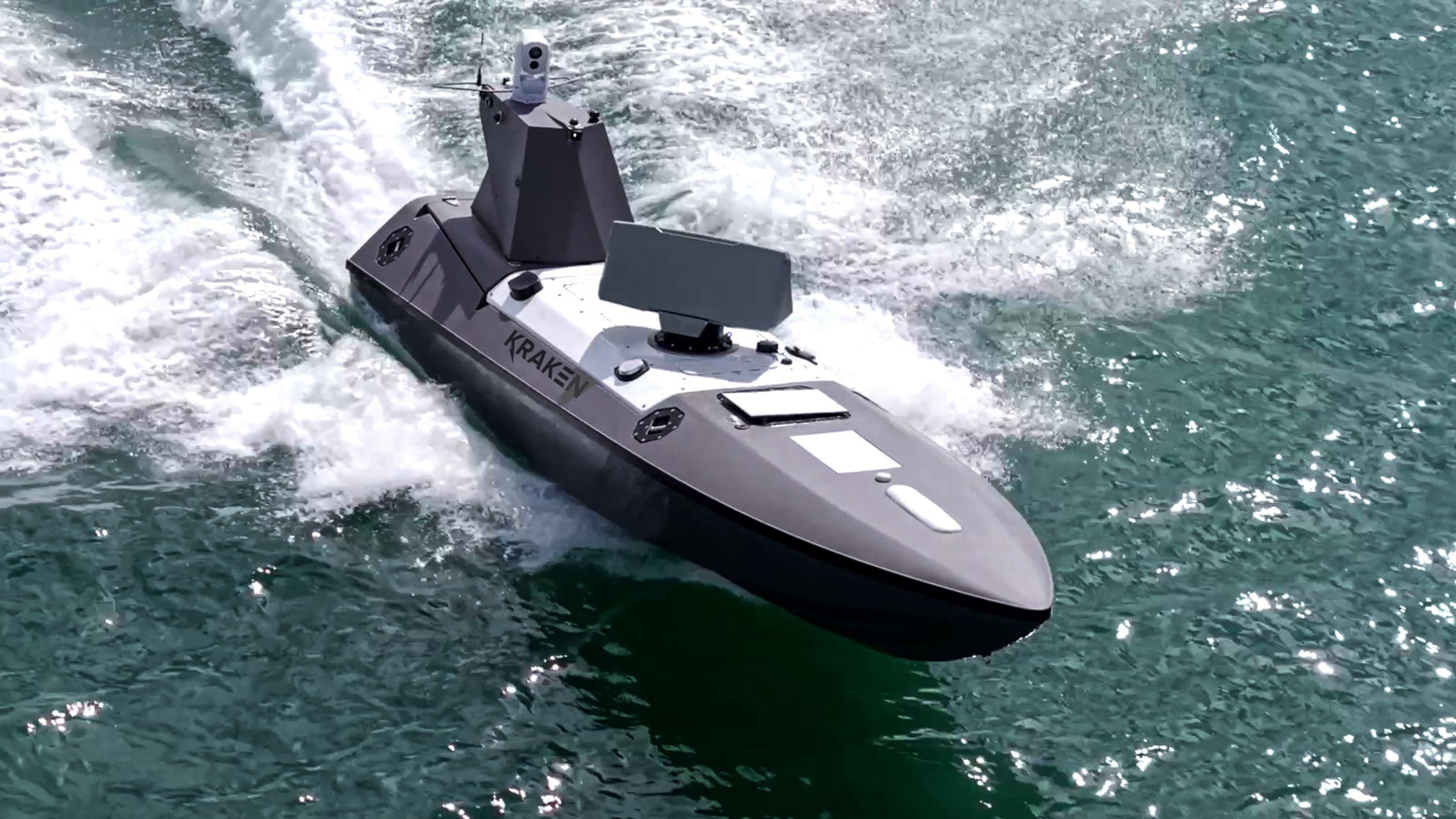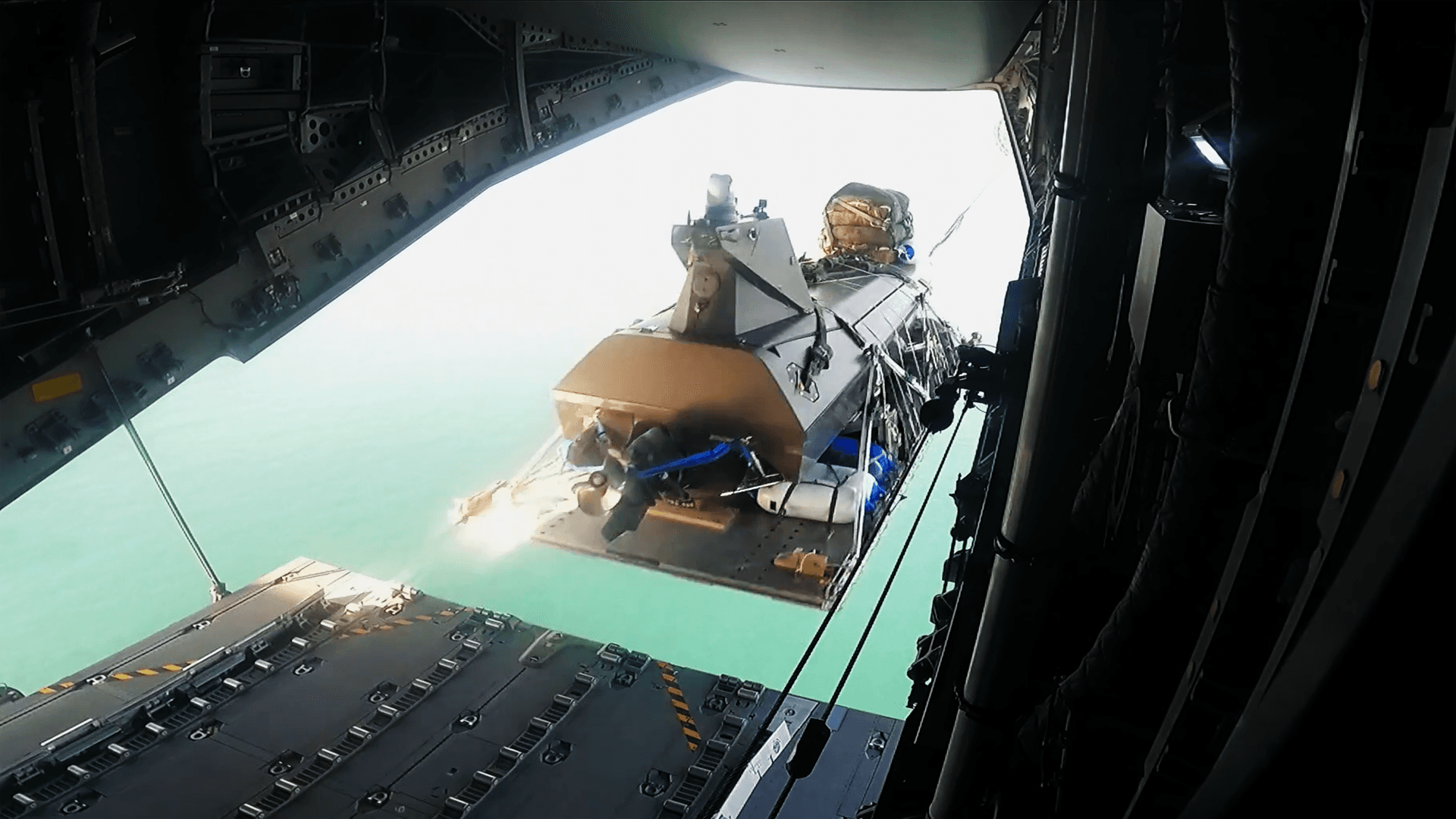
K3 SCOUT on UMCADS, was deployed via extracted load airdrop from an A400M at 1,300 feet, demonstrating a new rapid-insertion capability for force-projection of USVs.
Fareham, UK / Connecticut, USA: Kraken Technology Group and Capewell, supported by the Royal Navy under Project Beehive, have successfully completed the world’s first extracted-load airdrop of an uncrewed surface vessel (USV) from an A400M military transport aircraft.
During a series of pioneering trials, a Project Beehive specification K3 SCOUT USV was deployed on Capewell’s Universal Maritime Craft Aerial Delivery System (UMCADS) multiple times from an altitude of 1,300 feet into waters of up to Sea State 4. These demonstrations successfully proving a new force projection capability to rapidly insert high-performance uncrewed vessels into contested or difficult-to-access maritime environments.
The trials combined Kraken’s K3 SCOUT optional airdrop kit with Capewell’s reconfigurable Type V parachute-based UMCADS platform, which can airdrop various maritime vessels directly into military zones. The trial campaign culminated with a successful validation of a pioneering new IN-Release system, a configurable electro-mechanical release mechanism which enables reliable, synchronised load disconnect across a wide range of aerial and maritime applications.
These tests prove that K3 SCOUTs can be inserted directly by air and enter the water ready for operation, significantly expanding the speed, range, and flexibility with which uncrewed maritime capabilities – such as those procured for the UK’s Hybrid Navy in Project Beehive – can be deployed.
Mal Crease, Founder and CEO of Kraken Technology Group, said:
“Working in partnership with Capewell and the Royal Navy, we have demonstrated that K3 SCOUT can be rapidly deployed directly from a military transport aircraft into contested or difficult-to-access waters ready for operation. Kraken, alongside its partners and the Royal Navy, will continue to push boundaries to deliver novel and enhanced operational capabilities with our resilient, modular platforms.”
Mark Lavender, Director of Business Development and Training at Capewell said:
“In collaboration with Kraken we were able to validate the integration of a complex payload with our UMCADS platform while demonstrating the ease with which the system can be reconfigured for alternative mission essential equipment be they maritime or land applications. This was further validated in that we conducted 4 live airdrops in 6 working days with the same boat and platform during this campaign.”